
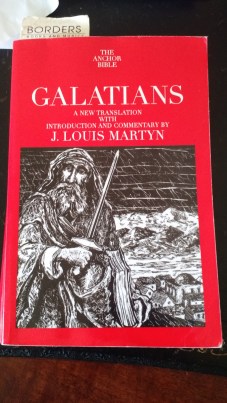
It’s the summer of Paul. I needed a reason/excuse to read this tome. And, this summer Galatians appeared in the lectionary, good reason/excuse.
In seminary, I had the good fortune to take a course at Notre Dame University concerning Paul and his letters, taught by the late Jerome Murphy-O’Connor. Of course we used his book, Paul: A Critical Life, another tome, but a very good, and thorough read.
Before Murphy O’Connor’s class I was ambivalent about Paul and his letters, because he is often used by Christian fundamentalists, who subscribe to Biblical literal-ism to spread a gospel antithetical to Jesus. Ironically, these folks will use Paul to advocate a nomistic religion, which is, of course, exactly what Paul is rejecting in the Letter to the Galatians.
Having lived about twenty five years in Texas, where churches and preachers of the Southern Baptist Convention seemed to to dominate public theology, I’ve heard an awful lot of fundamentalist/literalist Christianity like this.
But, Murphy- O’Connor taught me an appreciation of Paul. Moreover, like many other readings that I learned in seminary, a careful reading of the text itself doesn’t support the interpretations I had heard, and still hear, from fundamentalist/literalist Christians.
Murphy-O’Connor recommended this book, and, although weighty at times, particularly when he is discussing issues surrounding translation, it’s a truly worthwhile read. It has been instructive and freeing to read Martin describe Paul’s concept of sin and evil as a “force” or “power”, similar to Murphy-O’Connor, and the kind of reading that is compatible with the writings of Walter Wink. For Paul, according to Martin and Murphy-O’Connor sin is not a minutiae of little acts. Instead, it’s a force that compels, if you will, humankind to act in ways contrary to it’s nature and contrary to the desire of God for God’s good creation.
This of course is tied to, what Martin calls, Paul’s “apocalyptic theology”, that “the present evil age” is so powerful that only the invasion of God, the incarnation, could free humankind from the grip of this “power”. And, the crucifixion, along with the resurrection are the victory of God, through Jesus, over “the present evil age” — sounds like Christus Victor atonement to me.
In her book, Deceiving the Devil: Atonement, Abuse and Ransom, Darby Ray describes the debilitating effects of a traditional atonement theory that ties sin and guilt together has on victims of abuse. According to Martin regarding Galatians and according to Murphy-O’Connor regarding the Pauline corpus Paul’s concept of sin doesn’t support that kind of reading, which makes it easier for me to embrace him.
So, along with this book, I’m reading a few others this summer, or perhaps into the fall.
My ambivalence regarding Paul is giving way to finding a place for him, and his gospel, in my own theology.

 I've Been Thinking
I would love to hear from you